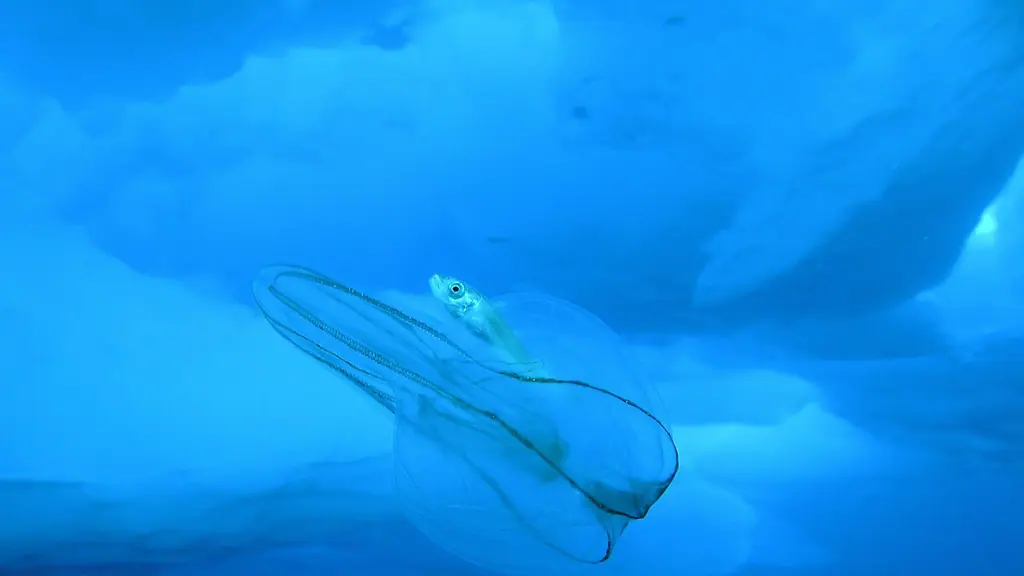
Cut a core through a metre of first-year sea ice in spring and hold it up to the light. The lower few centimetres are often stained brown. That colour is life: diatoms and other single-celled algae packed into a maze of brine channels, grazed by tiny worms and crustaceans that spend their whole lives inside the ice. Drop a net through the hole and you pull up copepods the size of rice grains. Lower a camera to the seabed and you find brittle stars, sea cucumbers and sponges.
The Arctic Ocean is often pictured as an empty white lid on a dark sea. In reality it supports three linked communities, one in the ice, one in the water and one on the seafloor, and scientists are still counting their members. This article explains how many species are known, where they live, why so many remain undescribed and how a warming ocean is reshuffling the list.
Counting the species: a census still in progress
The most complete tally comes from inventories assembled around the International Polar Year (2007–2009). A review led by Bodil Bluhm, published in Oceanography in 2011, put the number of known eukaryotic species (organisms whose cells have a nucleus, which excludes bacteria and archaea) in Arctic seas at close to 8,000. The authors expected several thousand more seafloor species to be recorded or discovered.
| Group | Known species (Bluhm et al. 2011) |
|---|---|
| Phytoplankton | close to 2,000 taxa |
| Ice-associated protists (single-celled organisms) | more than 1,000 |
| Ice-associated animals | more than 50 |
| Multicellular zooplankton | about 350 |
| Seafloor protists and invertebrates | more than 4,500 |
| Seaweeds (macroalgae) | at least 160 |
| Fish | 243 |
| Seabirds | 64 |
| Marine mammals | 16 |
Two points stand out. First, the large, familiar animals are a tiny share of the total: the 16 marine mammals (eight whales, seven seals and the polar bear) are outnumbered roughly 280 to one by seafloor invertebrates and protists. Second, the numbers are a record of effort as much as of nature. The deep basins and the ice-covered interior have been sampled far less than the shelves of the Barents and Chukchi seas, and bacteria and archaea are not included at all.
Arctic marine biodiversity is concentrated in small organisms and on the seafloor. The figures above are minimum counts that grow whenever a poorly sampled region or season is visited.
Three realms: ice, water and seafloor
Biologists divide Arctic marine life into three environmental realms. Bluhm and colleagues found endemic and abundant species in all three, and across many animal phyla.
Life inside the ice
Organisms that live in or on sea ice are called sympagic. When seawater freezes, salt is squeezed out into a network of brine channels a fraction of a millimetre wide. Diatoms colonise these channels and the ice underside as soon as spring light returns, and their bloom starts weeks before open-water plankton can grow. Amphipods (shrimp-like crustaceans), flatworms, rotifers and copepod larvae graze on them. Because this community depends on ice that persists, it is the one most directly exposed to sea-ice loss.
The ice community also feeds the deep sea. During the record-low ice summer of 2012, the German icebreaker Polarstern found widespread clumps of ice algae on the floor of the central Arctic basins, deposited at an average of 9 grams of carbon per square metre (Boetius et al., Science, 2013).
Life in the water column
The open water hosts phytoplankton blooms, zooplankton and the animals that eat them. Copepods are the largest group of zooplankton: of the roughly 350 species in the inventory, 161 are copepods. A handful of large, fat-rich species dominate the biomass and carry energy up the food web, as explained in our article on Calanus copepods. Polar cod, plankton-eating seabirds such as the little auk, and baleen whales depend on them; our guide to Arctic food chains follows those links step by step.
Arctic fish are dominated by two bottom-living groups. In the 2011 inventory, sculpins (72 species) and eelpouts (55 species) made up more than half of the region's fish. Only 41% of the fish species had Arctic, predominantly Arctic or Arctic–boreal distributions; the rest were boreal (temperate northern) or widely distributed species, many of which reach the Arctic only at its Atlantic and Pacific margins.
Life on the seafloor
The seafloor holds most of the known species. Crustaceans and polychaete worms lead the shelf lists, and an inventory of deep-sea fauna below 500 metres listed 1,125 taxa. Deep Arctic communities can be surprisingly rich. On the peaks of extinct volcanic seamounts on the Langseth Ridge, at 87°N, the Polarstern expedition of September–October 2016 found dense sponge gardens holding about 460 grams of carbon per square metre. Plankton production at the surface could supply less than 1% of the carbon the sponges need; isotope evidence suggests their symbiotic microbes tap old organic matter, including the remains of an extinct seep community (Morganti et al., Nature Communications, 2022).
Why so many species are still unknown
Several things make the Arctic hard to census.
- Access. The central basins are ice-covered most of the year and can only be reached by icebreakers. Each deep station can take many hours of ship time.
- Seasons. Most sampling has happened in summer. Winter campaigns are recent, and they keep changing ideas about what is active when; see our article on life in the polar night. In December 2019, for example, a Nansen Legacy cruise on the icebreaker Kronprins Haakon sampled shelled pteropods and foraminifera along a line from 82°N to 76°N in full darkness (Zamelczyk et al. 2021).
- Look-alike species. Many small animals can only be told apart with genetic tools. Studies of Arctic copepods have found that identifications made under the microscope can be badly wrong, which affects estimates of how fast species ranges are shifting.
- Few long time series. The Conservation of Arctic Flora and Fauna working group (CAFF) concluded in its 2017 State of the Arctic Marine Biodiversity Report that monitoring was not sufficient to describe status and trends for many of the six ecosystem components it assessed: sea-ice biota, plankton, benthos, fish, seabirds and marine mammals.
A changing species list
Much of the biodiversity change now being measured in Arctic seas is about who lives where. As the ocean warms and ice retreats, species from the south move north, and species tied to cold water and ice lose habitat.
The clearest example comes from the Barents Sea. Using bottom-trawl surveys from 2004 to 2012, Fossheim and colleagues showed that boreal fish communities expanded north at a pace matching local warming, while the Arctic fish community retreated towards the deep basin edge (Nature Climate Change, 2015). They called this process borealisation. It is part of the wider shift described in our article on Atlantification of the Barents Sea.
Change is not always a straightforward loss. Total species numbers in a given area can rise as newcomers arrive, even while specialised Arctic species decline. That is why ecologists track the composition of communities, not just how many species are present. The contrast with the Southern Ocean, where a different set of species fills similar roles, is explored in Arctic vs Antarctic ecosystems.
Exploring further
- The CAFF report and its data portal give circumpolar summaries of each ecosystem component and list where monitoring is missing.
- Bluhm et al. (2011) is open to read and includes the full species table by group; it is a good starting point for student projects comparing realms.
- For a classroom exercise, ask students to rank the groups in the table above by how often they appear in news coverage, then compare that ranking with species counts. The mismatch makes a useful discussion about what we notice and what we study.
More articles on this theme are collected under Arctic Biodiversity.
Sources
- Arctic marine biodiversity: an update of species richness and examples of biodiversity changeOceanography (Bluhm et al. 2011)
- State of the Arctic Marine Biodiversity ReportConservation of Arctic Flora and Fauna (CAFF)
- Giant sponge grounds of Central Arctic seamounts are associated with extinct seep lifeNature Communications (Morganti et al. 2022)
- Recent warming leads to a rapid borealization of fish communities in the ArcticNature Climate Change (Fossheim et al. 2015)
- Distribution and abundances of planktic foraminifera and shelled pteropods during the polar night in the sea-ice covered northern Barents SeaFrontiers in Marine Science (Zamelczyk et al. 2021)
Spotted an error? Email contact@nansenlegacy-symposium.com with the page address. See our editorial policy.