Scrape the underside of a floe in the Barents Sea in April and the ice comes away stained brown. The colour belongs to diatoms, single-celled algae that live in the bottom few centimetres of the ice and in its brine channels, growing in the dim light that filters through snow and ice while the sea below is still dark and cold. They are the first course of the Arctic year.
From that brown film, energy moves up through a short, efficient food chain: algae to tiny crustaceans, crustaceans to fish, fish to seals and seabirds, seals to polar bears. What makes the chain work is not so much the number of organisms as the quality of the food passed along, and above all its fat.
This article traces that chain link by link, explains why lipids matter so much in a seasonal ocean, and describes how a warmer, less icy Arctic is reshaping who eats whom.
Two blooms, one short season
Almost all the energy in the Arctic marine food web comes from photosynthesis by microscopic algae, and Arctic algae have a very short window. Through the polar night there is no light to grow. In spring, two groups of producers take turns.
Ice algae come first. Living in and under the sea ice, they start growing while the ice is still solid, using the faint light that penetrates it. Phytoplankton, the algae that drift in open water, bloom later, once the ice breaks up or thins and the sun can reach the surface layer.
A field study on the shelf seas around Svalbard, published in 2010 by Søreide and colleagues, followed both groups through a season. They found two peaks in the algae's content of long-chain omega-3 fatty acids, which animals need for growth and reproduction but cannot make themselves: the first in late April at the onset of the ice algal bloom, and the second in early July just after ice break-up, at the start of the phytoplankton bloom. The timing of reproduction and growth of the copepod Calanus glacialis matched both peaks: females used the ice algae to fuel early egg production, and their offspring then fed on the phytoplankton bloom.
In the Arctic, when food appears matters as much as how much. A grazer that hatches a few weeks too late can miss the bloom entirely. Scientists call this risk a timing mismatch.
Calanus: turning algae into fat
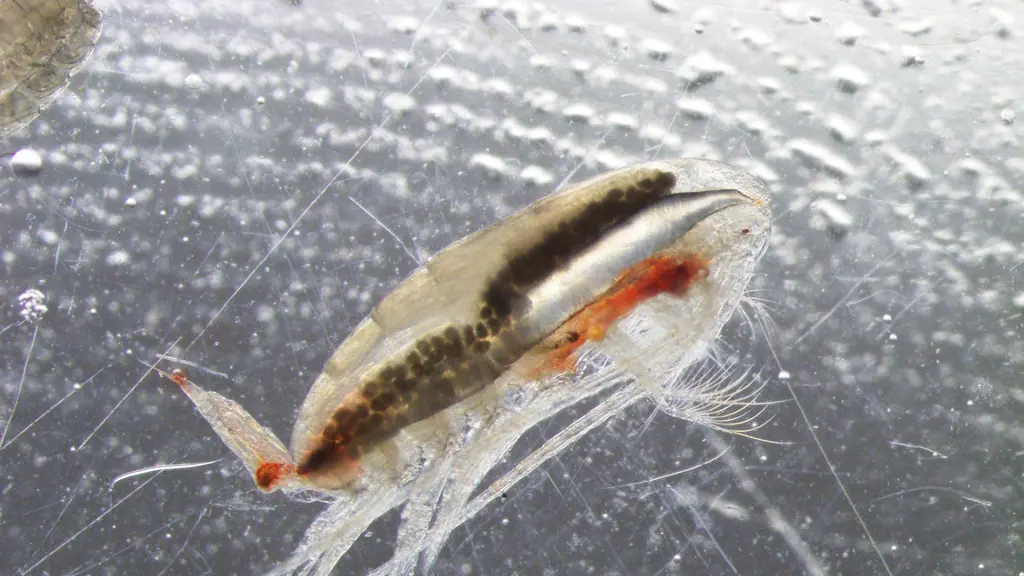
The key link between algae and almost everything larger is a group of copepods, small crustaceans a few millimetres long, in the genus Calanus. Three species matter most in Arctic waters: the Atlantic C. finmarchicus (the smallest), and the Arctic C. glacialis and C. hyperboreus (the largest).
Their great talent is storage. In a review of their biology, Falk-Petersen and colleagues described Arctic Calanus as key converters of low-energy carbohydrates and proteins from algae into high-energy wax esters, a type of lipid stored in a large oil sac. Feeding intensively during the brief bloom, the copepods build up fat, then sink to deeper water to spend the dark months in a resting state. That stored energy makes them a concentrated, high-value meal for fish, seabirds and even bowhead whales.
Size matters to their predators. MOSJ, Norway's environmental monitoring programme for Svalbard, notes that little auks strongly prefer the larger Arctic species. When small Atlantic C. finmarchicus dominate a fjord, the birds may need to fly further to find C. glacialis, which can reduce their breeding success. In Kongsfjorden on Svalbard's west coast, monitoring since 1996 shows C. finmarchicus dominating in most years since 2007, and the two Arctic species made up only about 2% of the Calanus population in late July 2023 and about 9.7% in 2024. Our profile of Calanus copepods looks at these animals in detail.
Polar cod: the pivot of the food web
The next link is a small fish. Polar cod (Boreogadus saida), also called Arctic cod, rarely grows longer than a hand, yet it is central to the system. MOSJ describes it as the only strictly Arctic pelagic fish in the Barents Sea, adapted to water down to freezing point, and as prey for Atlantic cod, seabirds and seals. Young polar cod shelter in cracks and crevices on the underside of the ice, feeding on copepods and ice-associated amphipods.
Polar cod are a link that is under pressure. Autumn acoustic surveys in the Barents Sea, run since 1986, put the stock at about 10% of its long-term average in both 2024 and 2025, and below average in most years since 2012. MOSJ notes that traditional spawning areas in the south-east Barents Sea are now used very little, and that spawning occurs almost exclusively around Svalbard. Declining ice and warming are expected to shrink the fish's habitat further. More on this species is in Polar cod: the small fish holding the Arctic food web together.
Seals, seabirds and the top predator
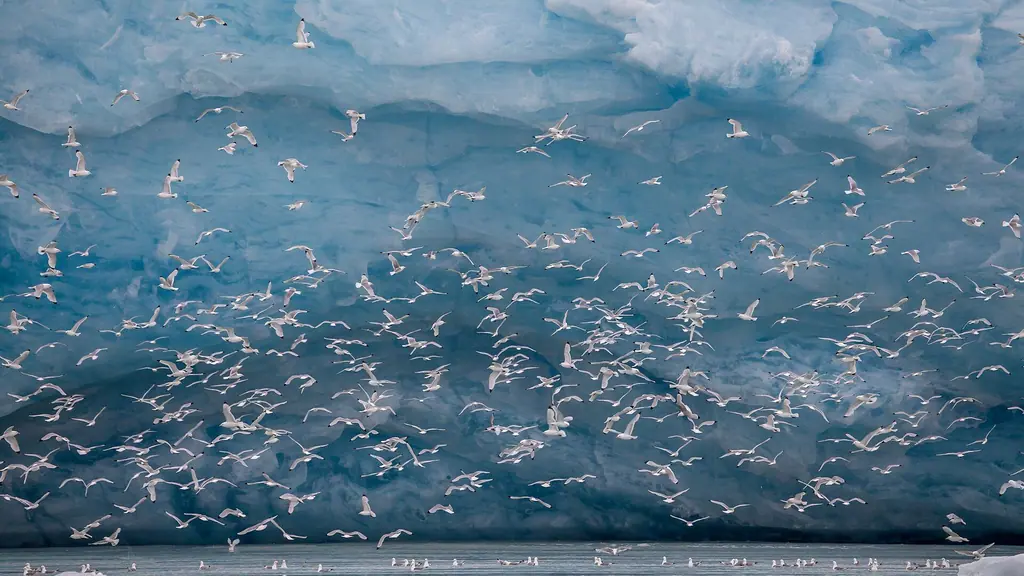
Polar cod and crustaceans feed the Arctic's warm-blooded predators. Ringed seals, the most ice-dependent seal, eat fish and crustaceans and give birth in snow lairs on the sea ice. Seabirds such as Brünnich's guillemots and black-legged kittiwakes dive or dip for fish and zooplankton near the ice edge, while little auks specialise in copepods. Bowhead whales skip the middle links entirely and filter copepods directly from the water.
At the top sits the polar bear. The Alaska Department of Fish and Game lists ringed seals as its main prey, with bearded seals, walruses and beluga whales also taken. Bears hunt at breathing holes, stalk seals resting on the ice and break into snow lairs to catch females and pups. Bears preferentially eat the blubber, which is where the lipids that began in ice algae and Calanus end up concentrated. How bears cope with their high-energy lifestyle is covered in how polar bears are adapted to life on the sea ice.
The seafloor connection
Not every bloom is eaten in the water. On the shallow Arctic shelves, especially early in the season before grazers have built up their numbers, a large share of the algae sinks to the bottom. There it feeds a rich community of clams, worms, brittle stars and crustaceans. Ecologists call this link benthic–pelagic coupling, the exchange of food and nutrients between the seafloor (benthic) and the water column (pelagic).
That seafloor food supports some of the Arctic's largest animals. Walruses dive to suck clams from the sediment, and bearded seals forage on bottom-living prey. When ice cover shortens and grazers in the water column take more of the bloom, less may reach the seafloor, potentially shifting energy from the bottom-feeding branch to the open-water branch.
Energy, efficiency and why fat matters
At each step up a food chain, most of the energy an animal eats is used for movement, keeping warm and other living costs, or is lost as waste. A common textbook approximation is that only around a tenth passes on to the next level, though real values vary widely. That is why food chains are short and why top predators are relatively few.
Arctic food chains offset this by trading in lipids, which hold roughly twice as much energy per gram as protein or carbohydrate. A seal eating a few fat-rich polar cod, or a fish eating lipid-packed copepods, gains far more energy per mouthful than it would from leaner prey. The system's efficiency depends on that fat being available at the right time and in the right place.
A food web in transition
Several changes are now visible in the data.
- More open water, more phytoplankton. NOAA's Arctic Report Card 2025 reports that satellite estimates of phytoplankton productivity rose about 80% in the Eurasian Arctic and 34% in the Barents Sea between 2003 and 2025, although the authors caution that part of the increase near the Eurasian coast may reflect river-borne dissolved material affecting the satellite signal.
- Atlantic species moving north. Smaller Atlantic copepods are replacing larger Arctic ones in places such as Kongsfjorden, and Atlantic fish such as cod and haddock have extended their ranges northwards.
- Pressure on ice-associated species. Polar cod biomass in the Barents Sea is at a low level, and species that need ice to rest, breed or hunt face a shrinking platform.
More algae does not automatically mean more food for top predators. If the extra production is passed through smaller, leaner prey, or arrives at a different time, less energy may reach seals and bears. Researchers are working to understand which effect will dominate in which region.
Write each organism from the diagram on a card, add Atlantic cod, capelin and a bowhead whale, and ask students to connect them with string or arrows. Then remove the sea ice card. Which organisms lose a habitat, a food source or both? Discuss which links might be replaced by Atlantic species.
To see how these links play out across habitats, from the ice to the seafloor, read our guide to Arctic ecosystems for students or browse the Marine Ecosystems topic.
Sources
- Timing of blooms, algal food quality and Calanus glacialis reproduction and growth in a changing Arctic (Søreide et al. 2010)Global Change Biology
- Zooplankton species composition in KongsfjordenMOSJ – Environmental Monitoring of Svalbard and Jan Mayen (Norwegian Polar Institute)
- Biomass of polar cod in the Barents SeaMOSJ – Environmental Monitoring of Svalbard and Jan Mayen (Norwegian Polar Institute)
- Lipids and life strategy of Arctic Calanus (Falk-Petersen et al. 2009)Marine Biology Research
- Arctic Report Card 2025: Arctic Ocean primary productivityNOAA
- Polar bear species profileAlaska Department of Fish and Game
Spotted an error? Email contact@nansenlegacy-symposium.com with the page address. See our editorial policy.