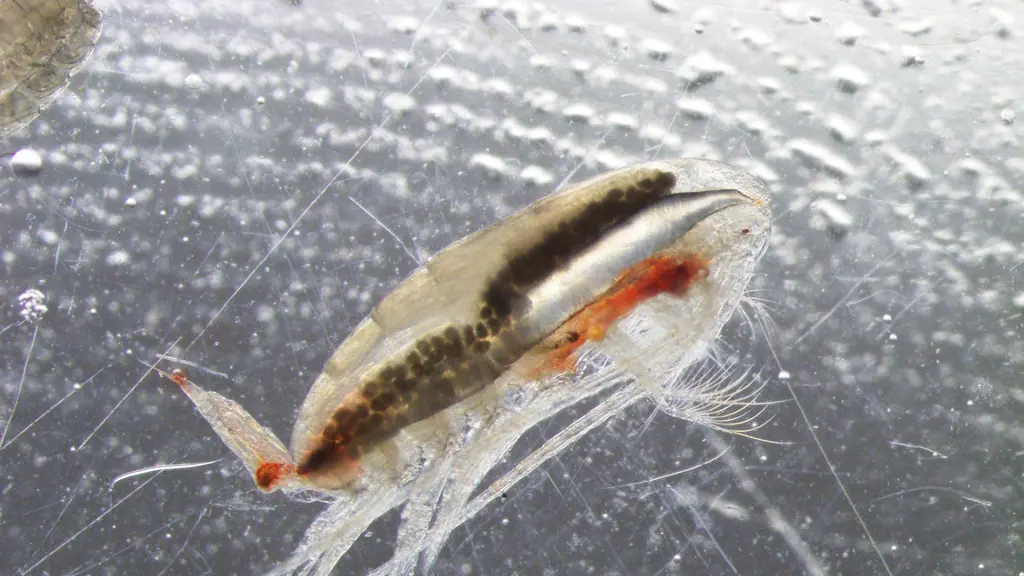
Pull a fine-meshed plankton net up through a Svalbard fjord in late summer and the catch often has a reddish tinge. Under a microscope, much of that colour resolves into copepods: small crustaceans a few millimetres long, with long antennae and a translucent body. Inside many of them is a glistening oil sac that can fill much of the body. That oil is the reason these animals, copepods of the genus Calanus, matter so much in the Arctic.
Three Calanus species dominate Arctic and sub-Arctic seas. They graze on ice algae and phytoplankton during the short productive season and convert that food into fat. Fish, seabirds and whales then eat them, so a large share of the energy in the Arctic food web passes through these animals. This article explains how they live, how they survive the long winter and why scientists are watching them as the Arctic warms.
Three species, three strategies
In a widely cited 2009 review in Marine Biology Research, Stig Falk-Petersen and colleagues described Calanus finmarchicus, C. glacialis and C. hyperboreus as the most important herbivores in Arctic seas in terms of biomass. They often live side by side but differ in size, lifespan and where they are most at home.
| C. finmarchicus | C. glacialis | C. hyperboreus | |
|---|---|---|---|
| Main home | North Atlantic, Norwegian and Barents seas | Arctic shelf seas | Deep basins: Greenland Sea, Fram Strait, Arctic Ocean |
| Adult female length (prosome) | 2.4–3.2 mm | 3.2–4.6 mm | 6.2–7.0 mm |
| Lipid in adult females (% of dry mass) | about 31% | about 70% | about 62% |
| Typical life cycle | One year | Often two years | One to two years, up to four to six in some regions |
| Spawning | April–May, during or just after the spring bloom | Just before or during the ice-algae and phytoplankton bloom | October–March, on stored fat alone |
Values from Falk-Petersen et al. (2009), compiled from earlier studies; lipid values are for Kongsfjorden, Svalbard. Lengths refer to the prosome, the main body section.
C. finmarchicus is the smallest and is best suited to the predictable spring bloom of the North Atlantic. C. glacialis is the Arctic shelf specialist, timing its reproduction to the bloom of ice algae and phytoplankton. C. hyperboreus, the giant of the three, lives in the deep, ice-covered basins where blooms are short and unpredictable, and it hedges its bets with a long life and huge fat reserves.
Fat as a survival strategy
Arctic algae grow for only a few months each year. To survive the rest, Calanus store energy as lipids, mainly wax esters, a type of fat that packs a great deal of energy into a small volume. According to Falk-Petersen and colleagues, the three species have total lipid contents that can exceed 50% of their dry mass, and wax esters make up 70–90% of that lipid.
These wax esters are built from long-chain fatty alcohols and acids, particularly ones with 20 and 22 carbon atoms (written 20:1 and 22:1), which the copepods make themselves. They are an exceptionally rich store: the review notes that breaking down one mole of the 22:1 fatty acid yields 182 moles of ATP, the molecule cells use as an energy currency.
Ice algae and phytoplankton are mostly made of carbohydrates and proteins, which are relatively low in energy. Calanus copepods turn that material into energy-dense fat. That conversion is why so many larger Arctic animals can thrive on a food web that runs on a short summer.
A year in the life: up in summer, down in winter
All three species follow a similar annual pattern of vertical migration, shown in simplified form below.
In spring and summer, young copepods feed intensively near the surface, growing through a series of juvenile stages called copepodites and filling their oil sacs. In late summer, the fat-rich older stages sink to deep water and enter diapause, a resting state with reduced metabolism. C. finmarchicus, for example, descends in June–July, according to the 2009 review, and returns towards the surface in late winter, ready to spawn. C. hyperboreus stages overwinter between about 500 and 2,000 metres in the deep basins.
Diapause is not the whole story. Moored acoustic instruments in Svalbard fjords have shown that zooplankton keep making daily vertical migrations through the polar night (Berge et al., Biology Letters, 2009), and C. hyperboreus spawns in winter, between October and March, entirely on stored fat. Its larvae are then ready to feed as soon as the spring bloom starts. Our article on life in the polar night describes how this winter activity was discovered.
Who eats Calanus?
Because they are abundant and rich in fat, Calanus copepods are a key link between algae and larger animals. In the Barents Sea, a 2018 analysis of three decades of survey data by Aarflot and colleagues at the Norwegian Institute of Marine Research found that Calanus species make up around 80% of mesozooplankton biomass (zooplankton roughly 0.2–20 mm in size).
- Fish. Polar cod, capelin and juvenile fish feed heavily on copepods; see our article on polar cod.
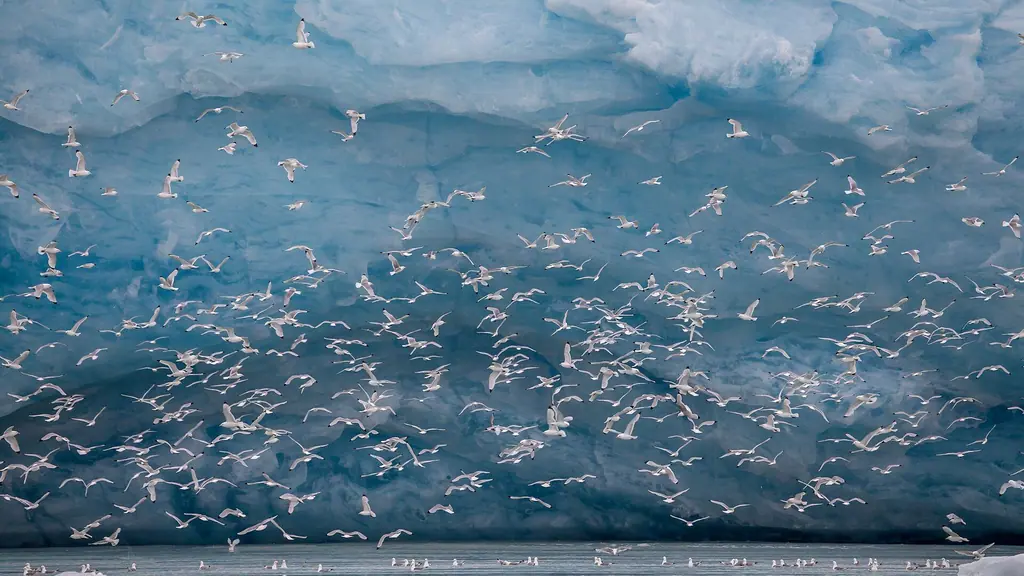
- Seabirds. The little auk, a small seabird that breeds in large colonies in Svalbard and Greenland, depends on large copepods to feed its chicks.
- Whales. Bowhead whales, the only baleen whales that live in the Arctic year-round, filter large quantities of zooplankton, including copepods.
The full chain from algae to top predators is traced in Arctic food chains explained.
Calanus in a warming Arctic
Because the three species prefer different water masses, Calanus are widely used as indicators of climate change. The general expectation has been that warming and the spread of Atlantic water, described in Atlantification of the Barents Sea, would favour the smaller, leaner Atlantic C. finmarchicus over the larger, fatter Arctic C. glacialis. A 2021 review by Randi Ingvaldsen and colleagues lists the northward expansion of boreal species and a growing role for the open-water food web among the ecological signs of Atlantification. Aarflot and colleagues reported a declining proportion of C. glacialis in the western Barents Sea over the preceding 20 years.
A shift from fat-rich to leaner copepods would matter for predators: a bird or fish would need to catch more individual prey to get the same energy.
A cautionary tale about identification
Telling C. finmarchicus from C. glacialis by eye is difficult, because their size ranges overlap. In a 2023 study in Scientific Reports, Kaja Balazy and colleagues identified 2,600 Calanus from the feeding grounds and diet of little auks around Svalbard, collected in the summers of 2019–2021, using both microscopes and genetic methods. Genetic analysis showed that as many as 40% of the individuals that were genetically C. glacialis were smaller than the size criteria predict, so they could be wrongly identified as C. finmarchicus by appearance. The little auks' diet consisted almost entirely of C. glacialis, even in the most Atlantic-influenced areas.
The authors concluded that the northward spread of C. finmarchicus may have been substantially overestimated, and that the main cost of Atlantification for the birds may come from C. glacialis becoming smaller rather than from a switch between species. It is a reminder that good science depends on good identification, a theme explored in Scientific methods in polar research.
Looking closer
- Many marine research institutes publish plankton survey results; look for time series of Calanus abundance and stage composition from the Barents Sea or the Norwegian Sea.
- In class, compare the lipid percentages in the table above and estimate how many C. finmarchicus a predator would need to eat to get the same fat as from one C. hyperboreus, using the dry masses reported in the 2009 review (about 0.26 mg for an adult female C. finmarchicus and 2.92 mg for C. hyperboreus).
More on Arctic food webs is collected under Marine Ecosystems.
Sources
- Lipids and life strategy of Arctic CalanusMarine Biology Research (Falk-Petersen et al. 2009), AWI repository
- Molecular tools prove little auks from Svalbard are extremely selective for Calanus glacialis even when exposed to AtlantificationScientific Reports (Balazy et al. 2023)
- Physical manifestations and ecological implications of Arctic AtlantificationNature Reviews Earth & Environment (Ingvaldsen et al. 2021)
- Diel vertical migration of Arctic zooplankton during the polar nightBiology Letters (Berge et al. 2009)
- Contribution of Calanus species to the mesozooplankton biomass in the Barents Sea (Aarflot et al. 2018)ICES Journal of Marine Science
Spotted an error? Email contact@nansenlegacy-symposium.com with the page address. See our editorial policy.