Arctic Seabirds and a Changing Ocean
Little auks, Brünnich's guillemots, kittiwakes and ivory gulls as indicators of ocean change, and what Norway's SEAPOP monitoring has recorded in Svalbard.
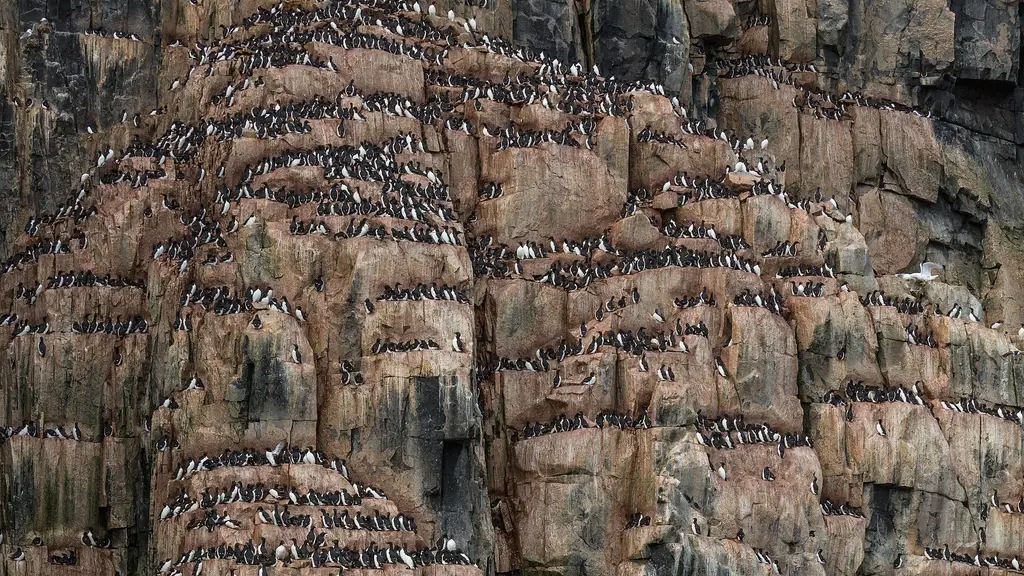
At Alkefjellet, on the shore of the Hinlopen Strait in north-eastern Svalbard, a dark cliff rises steeply from the sea, and in summer its ledges are packed with Brünnich's guillemots standing shoulder to shoulder over their single eggs. It is one of the colonies where Norwegian scientists count seabirds year after year, alongside sites on Bjørnøya and the west coast of Spitsbergen.
Those counts are more than bird-watching. Seabirds feed at sea but breed on land, where they can be counted, weighed and watched. Their breeding success, body condition and the food they carry back to their chicks are a running record of what is happening in the ocean beyond the cliff, often in places that ships rarely visit.
This article looks at four Arctic seabirds with very different ways of making a living, explains how Norway's monitoring programmes track them, and sets out what the records show as the Barents Sea warms.
Why seabirds are good ocean indicators
A seabird colony integrates a huge area of ocean. Adults may forage far from the nest, so a poor breeding season can signal a shortage of the right food anywhere within that range. Because many Arctic seabirds are long-lived, a fall in adult numbers usually reflects problems that have built up over several years rather than a single bad summer.
Seabirds also move nutrients from sea to land: the slopes beneath Arctic bird cliffs are often conspicuously green, fertilised by droppings from the colonies above.
Seabirds are useful indicators because they combine three signals in one place: what prey is available (chick diet), how much of it there is (breeding success and body condition) and how the population is responding over years (counts and adult survival).
How Norway monitors its seabirds
Norway's national monitoring of seabird populations began in 1980 and was formally established in 1988. In 2005 it was expanded into SEAPOP (SEAbird POPulations), a long-term programme covering mainland Norway, Svalbard and the surrounding seas. It is carried out by the Norwegian Institute for Nature Research (NINA) and the Norwegian Polar Institute, and funded by the Ministry of Climate and Environment, the Ministry of Energy and the offshore industry body Offshore Norge (SEAPOP). Selected results feed into MOSJ, the environmental monitoring system for Svalbard and Jan Mayen.
At each key site, the routine looks roughly like this:
- Count breeding birds in fixed study plots on the cliffs. For kittiwakes, MOSJ describes three counts of each plot being made on one to four occasions each season, using binoculars.
- Measure breeding success, the share of nests that produce a fledged chick.
- Sample chick diet by identifying the prey adults bring back to the nest.
- Estimate adult survival by resighting individually marked birds from year to year.
- Map birds at sea and track migrations to learn where colonies feed and spend the winter.
Our article on scientific methods in polar research explains why such standardised, repeated measurements matter more than any single count.
Four seabirds, four strategies
Little auk: a plankton specialist
The little auk (Alle alle) is the smallest of the European auks and an abundant breeder in Svalbard. Unlike the guillemots, it feeds mainly on plankton, diving for large, fat-rich copepods to bring back to its chick. A study of little auks in three west Spitsbergen fjords (Hornsund, Isfjorden and Kongsfjorden) between 2005 and 2020 found that late-stage individuals of the Arctic copepod Calanus glacialis made up roughly 60–70% of the prey items in chick meals, while late stages of its smaller Atlantic relative C. finmarchicus made up only about 12–17% (Descamps et al. 2022). The difference between the two copepods is explained in Calanus Copepods: The Arctic's Tiny Energy Powerhouses.
Brünnich's guillemot: the deep diver
Brünnich's guillemot (Uria lomvia) is a heavy, fast-flying auk that dives for fish and crustaceans. MOSJ counts about 615,000 pairs in 142 known colonies in Svalbard, and the species makes up over 60% of seabird biomass in the Barents Sea. Chicks on Spitsbergen are fed mainly polar cod, while those on Bjørnøya get mostly capelin (MOSJ). That makes the guillemot a direct link to polar cod, one of the key Arctic fish.
Black-legged kittiwake: a surface feeder
The kittiwake (Rissa tridactyla) is a small gull that cannot dive deeply and instead snatches prey from the top layer of the sea. Svalbard holds about 270,000 breeding pairs, around 90,000 of them on Bjørnøya (MOSJ). Because surface feeders can only reach prey near the surface, they tend to be sensitive to changes in where and when that prey is available.
Ivory gull: a bird of the ice
The ivory gull (Pagophila eburnea) is a pure white, high-Arctic gull tied to ice-filled waters all year round. It feeds at the edges of drifting ice and scavenges the remains of polar bear kills. The global breeding population is estimated at about 14,000 pairs, nesting in small, scattered colonies (MOSJ).
What the monitoring shows
| Species | Svalbard population | Recent trend | Norwegian Red List 2021 (Svalbard) | Likely drivers named by MOSJ |
|---|---|---|---|---|
| Brünnich's guillemot | About 615,000 pairs | Down about 4% a year since the mid-1990s; roughly a third lost in a decade at Bjørnøya and west Spitsbergen | Vulnerable | Warming in winter feeding areas near Iceland and Greenland; bycatch and oil pollution may contribute |
| Black-legged kittiwake | About 270,000 pairs | Decline until the mid-2000s, then mostly stable or increasing; more negative since about 2021 | Near Threatened | Cause of decline in some colonies unknown; avian influenza since 2021 likely contributed |
| Ivory gull | Part of about 14,000 pairs globally | Down about 7% a year in monitored colonies, 2015–2025 | Vulnerable | Loss of sea ice; high contaminant levels are a concern |
| Little auk | Not covered here | Diet shifts with Atlantic water inflow (2005–2020) | Not covered here | Atlantification of west Spitsbergen fjords |
The wider picture from mainland Norway, Svalbard and Jan Mayen is also negative. SEAPOP's report on the 2025 season, based on 15 key sites, found that 42% of monitored seabird populations declined between 2024 and 2025 and 38% increased. Over the last decade almost 60% of monitored populations declined, and almost three-quarters of populations of pelagic surface feeders, such as kittiwakes and fulmars, fell in 2025 (SEAPOP).
Two points help in reading these numbers. First, the guillemot decline seems to be driven mainly outside Svalbard: birds from west Spitsbergen and Bjørnøya spend the winter in the North Atlantic, and MOSJ links the decline most likely to ocean warming there. Second, the ivory gull series covers only 17 years, and MOSJ itself urges caution in interpreting it. Its decline is consistent with losses reported from Arctic Canada, where MOSJ notes a documented 70% decline in the breeding population.
Atlantification on the menu
The little auk study is a clear example of how a large-scale ocean change reaches an individual bird. As more warm, salty Atlantic water flows into the west Spitsbergen fjords, a process described in our article on Atlantification, Atlantic zooplankton become more common.
Descamps and colleagues found that in years with more Atlantic water inflow, the share of Atlantic prey in chick meals rose in all three fjords. Adults carrying more Atlantic prey were slightly lighter: a 50% increase in the Atlantic share was associated with about 3 g lower body mass, around 2% of body weight. In Hornsund, chick growth also tended to be lower when Atlantic prey made up more of the diet, although that result was only marginally significant (Descamps et al. 2022).
The authors are careful about the size of the effect. Atlantic water inflow explained only a small part of the variation in diet, body mass and chick performance, with sea ice, weather and differences between foraging areas also likely to matter. The study points to potential fitness costs of Atlantification, mostly for chicks late in the rearing period, rather than a collapse.
Watching the cliffs
Seabird science is one of the most accessible kinds of Arctic monitoring. SEAPOP publishes an annual key-site report each autumn, and MOSJ updates its indicator pages as new data arrive. When you read a new figure, check whether it describes a single season's breeding success or a multi-year population trend, and whether the colony winters in the Arctic or in the North Atlantic.
Give students the four species profiles above and ask them to rank the birds from most to least likely to be affected by (a) loss of sea ice and (b) warmer Atlantic water reaching Svalbard. Then compare their ranking with the trends in the table and discuss why a bird's diet and wintering area matter as much as where it breeds.
For the wider ecological setting of these birds, see Marine Biodiversity in the Arctic.
Sources
- About SEAPOPSEAPOP (Norwegian Institute for Nature Research and Norwegian Polar Institute)
- Report from the seabird monitoring in Norway in 2025SEAPOP
- Brünnich's guillemotMOSJ – Environmental Monitoring of Svalbard and Jan Mayen
- Black-legged kittiwakeMOSJ – Environmental Monitoring of Svalbard and Jan Mayen
- Ivory gullMOSJ – Environmental Monitoring of Svalbard and Jan Mayen
- Consequences of Atlantification on a zooplanktivorous Arctic seabird (Descamps et al. 2022)Frontiers in Marine Science
Spotted an error? Email contact@nansenlegacy-symposium.com with the page address. See our editorial policy.