Whales of the High Arctic: Bowhead, Narwhal and Beluga
The three whales that stay in the Arctic all year: how bowheads, narwhals and belugas use sea ice, how scientists listen for them and what threatens them.
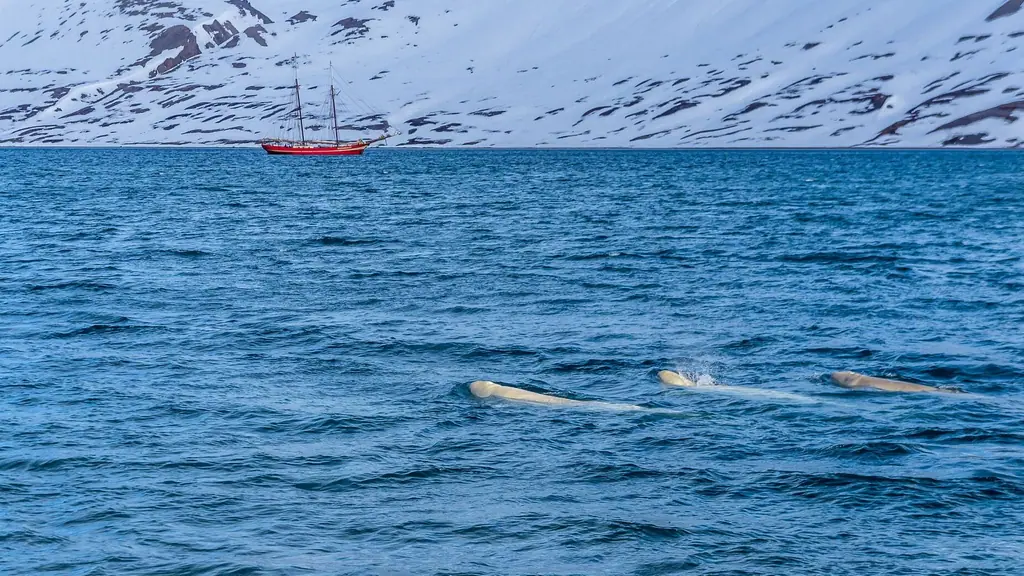
In 2006 a bowhead whale was seen in Adventfjorden, the fjord outside Longyearbyen, and the Norwegian Polar Institute describes the sighting as a true sensation. Whaling in the 1600s, 1700s and 1800s had almost driven the species to extinction there, and it has never fully recovered, so a single animal in a fjord made news (NPI).
Twelve species of whales are recorded in Svalbard waters, but most are summer visitors that arrive when food is plentiful. Only three stay all year: the bowhead whale, the narwhal and the beluga (also called the white whale). All three are adapted to living among sea ice, and all three are hard to study precisely because they live where ships struggle to go.
This article introduces each species, explains how scientists count and listen to them, and sets out the pressures they face as the ice changes.
Three residents compared
The table summarises figures from NOAA Fisheries, NAMMCO, the Norwegian Polar Institute and the Norwegian Red List (Artsdatabanken). Imperial figures in the original US sources have been converted to SI units and rounded.
| Bowhead whale | Narwhal | Beluga | |
|---|---|---|---|
| Scientific name | Balaena mysticetus | Monodon monoceros | Delphinapterus leucas |
| Type | Baleen whale (filter feeder) | Toothed whale | Toothed whale |
| Typical adult length | 14–18 m (Svalbard figures) | Up to about 5 m | Males up to about 4.5 m |
| Distinctive feature | Huge bow-shaped head; no dorsal fin | Spiralled tusk up to about 3 m in males; no dorsal fin | Pure white adults; flexible neck |
| Main food | Copepods, krill and other small crustaceans | Greenland halibut, polar and Arctic cod, squid | Fish and bottom-living invertebrates |
| Svalbard-area estimate | 343 (2015, East Greenland–Svalbard–Barents Sea stock) | At least 837 north of Svalbard (2015) | 549 (2018) |
| IUCN status | Least Concern globally (2018); Vulnerable in Europe (2023) | Least Concern (global 2017; Europe 2023) | Least Concern globally (2017); Vulnerable in Europe (2023) |
| Norwegian Red List 2021 (Svalbard) | Endangered | Vulnerable | Endangered |
The bowhead: two centuries in the ice
The bowhead is the only baleen whale that spends its whole life in Arctic waters. Instead of teeth it has long plates of baleen, a comb-like material made of keratin, which it uses to sieve small crustaceans from the water; NOAA Fisheries notes that bowheads have the longest baleen plates of any whale and estimates that one needs about 100 tonnes of prey a year (NOAA).
Its body is built for cold and ice. The insulating blubber layer can be close to half a metre thick, and the massive skull, more than 5 m long, lets bowheads break through sea ice around 20 cm thick to breathe. NOAA reports that the species may live for more than 200 years, and NAMMCO cites an Alaskan individual estimated at 211 years old (NAMMCO).
The bowheads around Svalbard belong to the East Greenland–Svalbard–Barents Sea stock, which commercial whaling nearly wiped out over almost 400 years. Estimates of its original size vary widely: one study suggested about 25,000 animals before exploitation, another about 52,500 adults between east Greenland and Spitsbergen in 1611. Until recently the survivors were thought to number in the tens. Helicopter and ship surveys north of Svalbard in 2015 produced an estimate of 343 animals, with a wide 95% confidence interval of 136–862, and NAMMCO lists the stock as increasing. The species has been protected in Svalbard since 1939.
A confidence interval of 136–862 does not mean scientists are guessing. It means that counting a few hundred animals spread across ice-filled water is genuinely difficult, and the true number could lie anywhere in that range. Wide intervals are a normal, honest feature of Arctic wildlife surveys.
The narwhal: the deep diver of the pack ice
The narwhal's tusk is an elongated tooth that grows forward from the upper jaw in a long spiral, mainly in males. The Norwegian Polar Institute gives a maximum length of about 3 m. Narwhals are shy and quickly move away from boats; around Svalbard they are most often recorded at the ice edge, in the fjords of Nordaustlandet and in the Hinlopen Strait (NPI).
Narwhals are remarkable divers. To reach Greenland halibut on the seabed they dive to 800–1,600 m, with dives lasting up to 25 minutes. In winter they live among heavy pack ice over water up to 2,000 m deep; in Baffin Bay they can winter in areas with as little as 0.5% open water (NAMMCO).
NAMMCO gives a rough world population of 85,000–100,000. Around Svalbard the numbers are far smaller and poorly known: a survey of the marginal ice zone north of the archipelago in August 2015 estimated 837 narwhals, which NAMMCO describes as a likely minimum because not all possible habitat was covered. Nearby East Greenland populations are small and depleted.
The beluga: the glacier-front specialist
Belugas are born brown or slate-grey and lighten with age until they are pure white. NAMMCO says females turn white after about 14 years and males after about 18; the Norwegian Polar Institute gives earlier ages, a reminder that such figures vary between populations and studies. Unlike most whales, belugas have unfused neck vertebrae and can turn their heads, and they are famously vocal: NOAA Fisheries notes their nickname, "canaries of the sea", for their whistles, squeals, chirps and clicks (NOAA).
Svalbard's belugas stay close to the archipelago all year. In summer they spend much of their time near glacier fronts, often in groups separated by sex. When the sea freezes they are pushed further offshore but remain nearby. Satellite tags have shown that tagged animals did not make long migrations, and Norwegian researchers have even used tagged belugas as "adaptive samplers" to measure temperature and salinity under the ice. The first survey of the area, in summer 2018, estimated 549 animals (95% CI 436–723), making Svalbard the smallest of the beluga stocks in the NAMMCO area (NAMMCO).
Listening instead of looking
Whales that live under ice through the polar night are almost impossible to count by eye in winter. Scientists therefore listen. Passive acoustic monitoring uses underwater microphones (hydrophones) fixed to moorings that record for a year or more before a ship recovers them. Our article on moorings, gliders and robots under the ice explains how such instruments are deployed.
NAMMCO summarises what this has revealed in Fram Strait, between Greenland and Svalbard. Norwegian waters have been monitored acoustically since 2008. Recorders in western Fram Strait picked up bowheads calling or singing continuously from November to April, showing that the strait is a wintering and probably a mating area for the stock. One study found 184 different song types over three years, an extraordinary variety for a whale population of only a few hundred animals (NAMMCO).
Pressures on Arctic whales
These three species face a combination of pressures. Their relative importance differs between species and regions, and scientists are cautious about predicting outcomes:
- Loss of sea ice. All three are adapted to ice-covered water. Around Svalbard, NAMMCO notes that bowhead sightings have increased north of the archipelago and decreased in coastal fjords, following the retreating ice edge.
- Noise. Whales depend on sound to find food, navigate and communicate. NOAA Fisheries reports that seismic survey noise displaced bowheads from waters within about 19 km of the source, and that ship noise can mask beluga calls.
- Shipping. As ice retreats, more vessels enter Arctic waters, raising the risk of disturbance and collisions.
- Predators and competitors. NAMMCO notes that killer whale predation on belugas may increase as sea ice declines, while boreal species move north into Arctic waters (see Atlantification).
- Contaminants. Long-lived top predators accumulate pollutants from their prey over many years.
Following the evidence
New survey estimates for these whales appear only every few years, so each one matters. When you meet a population figure, look for the year of the survey, the area covered and the confidence interval. A single estimate with a wide interval tells you the order of magnitude; repeated surveys over decades tell you the trend.
For the food web that supports these whales, from ice algae to fish, see Arctic Food Chains Explained and our profile of polar cod, one of the fish narwhals depend on.
Sources
- The Cruise Handbook for Svalbard: Svalbard's wildlifeNorwegian Polar Institute
- Bowhead whaleNOAA Fisheries
- Bowhead whaleNAMMCO – North Atlantic Marine Mammal Commission
- NarwhalNAMMCO – North Atlantic Marine Mammal Commission
- BelugaNAMMCO – North Atlantic Marine Mammal Commission
- Beluga whaleNOAA Fisheries
Spotted an error? Email contact@nansenlegacy-symposium.com with the page address. See our editorial policy.