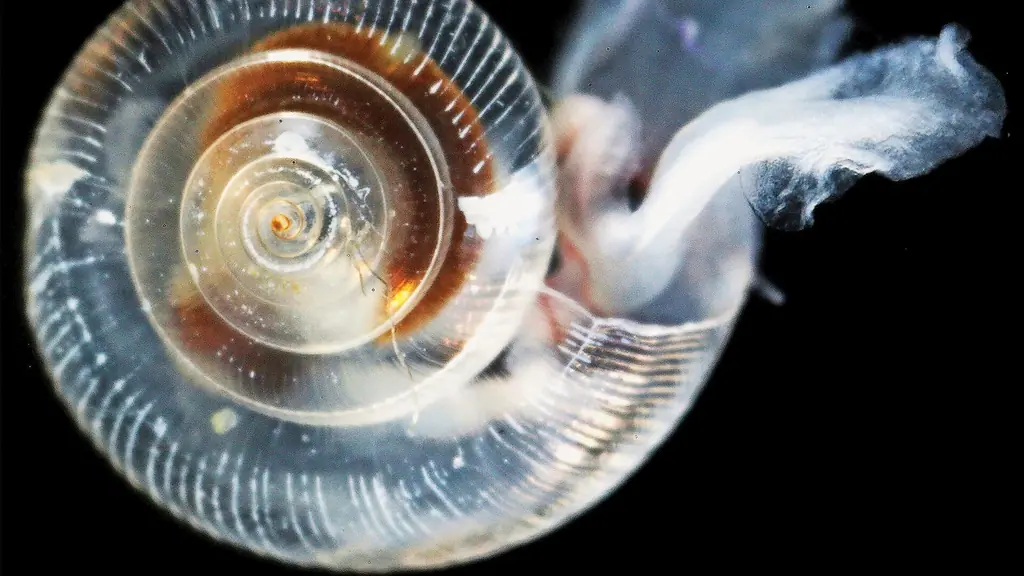
In the upper few hundred metres of the Arctic Ocean drifts a snail the size of a lentil. Limacina helicina, a shelled pteropod or "sea butterfly", swims by flapping two lobes of its foot and builds a delicate shell of aragonite, a form of calcium carbonate. It is eaten by fish and seabirds, linking it to the wider food web. It is also one of the animals that marine chemists watch most closely, because the water it lives in is changing chemically faster than almost anywhere else on Earth.
Ocean acidification is often described as "the other carbon dioxide problem". It is not about temperature but about chemistry: as the ocean absorbs carbon dioxide from the air, seawater becomes more acidic and loses some of the carbonate that shell-building organisms need. This article explains the chemistry, why cold Arctic water is especially exposed, what measurements show and what is known, and not yet known, about the effects on Arctic life.
The chemistry in four steps
The ocean is a huge carbon sink. The IPCC's Special Report on the Ocean and Cryosphere (2019) found that it has taken up between 20 and 30% of total human carbon dioxide emissions since the 1980s. That uptake slows atmospheric warming, but it changes seawater:
- Carbon dioxide dissolves in seawater and reacts with water to form carbonic acid.
- Carbonic acid releases hydrogen ions (H⁺) and bicarbonate ions.
- More hydrogen ions mean lower pH, the scale chemists use for acidity.
- Many of the extra hydrogen ions combine with carbonate ions (CO₃²⁻), turning them into bicarbonate. Carbonate becomes scarcer.
Because pH is a logarithmic scale, small numbers hide large changes: a fall of 0.1 pH units means about 26% more hydrogen ions. The IPCC found that open-ocean surface pH has declined by 0.017–0.027 units per decade since the late 1980s, very likely already outside the range of natural variability.
Saturation state: the number shell-builders care about
Chemists summarise whether seawater favours shell-building with the saturation state, written Ω (omega). It compares the actual concentrations of calcium and carbonate ions with the concentrations at which calcium carbonate neither forms nor dissolves. When Ω is above 1, the mineral is stable; below 1, water is undersaturated or corrosive, and unprotected shells tend to dissolve. Aragonite, the form used by pteropods and many molluscs, is more soluble than calcite, so it becomes undersaturated first.
Why the Arctic is changing fastest
The Arctic Monitoring and Assessment Programme (AMAP), in its 2018 assessment, gave three reasons why some of the fastest rates of acidification are occurring in the Arctic:
- Cold water absorbs more CO₂. Gases dissolve more readily in cold water, so polar seas take up more carbon dioxide per litre. Cold waters also naturally hold less carbonate, so they start closer to Ω = 1.
- Fresh water dilutes the buffer. River run-off and melting sea ice add large amounts of fresh water, which lowers the concentrations of the ions that buffer seawater against acidity.
- Pacific inflow. Water entering through the Bering Strait is naturally lower in pH, adding to the effect on the Pacific side of the Arctic.
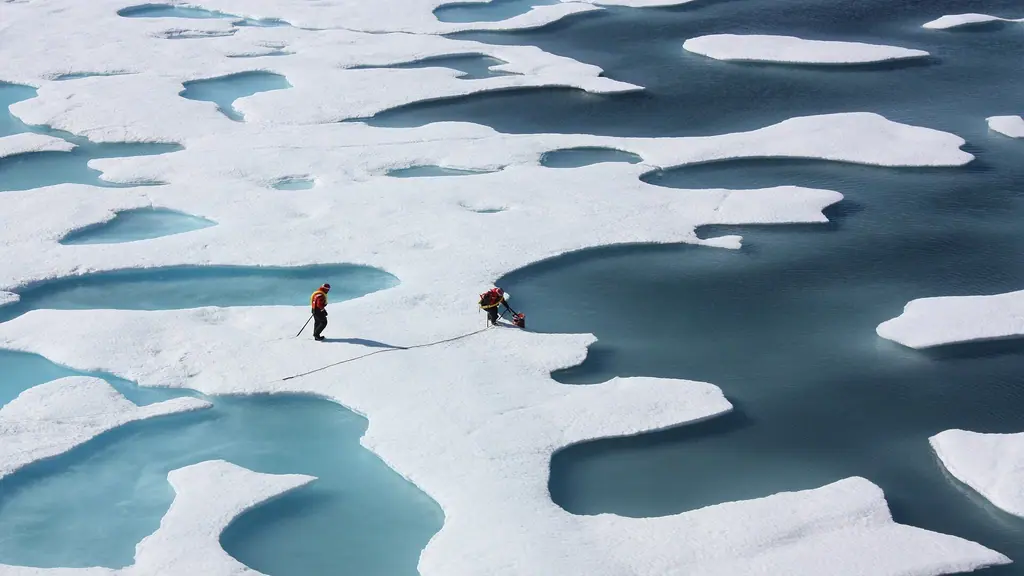
Sea-ice loss adds a fourth factor. Ice acts as a lid on gas exchange. When it melts, the newly exposed surface water, already diluted by meltwater, can absorb CO₂ from the air quickly. Di Qi and colleagues, analysing measurements from 1994 to 2020 in the western Arctic Ocean (Science, 2022), found acidification there running at three to four times the rate seen in other ocean basins, and attributed it to this combination of meltwater dilution and enhanced CO₂ uptake as the ice retreated. Their records show low-pH water first appearing in the southern Canada Basin in the early 2000s and then spreading north.
Arctic acidification is driven by the same global cause as everywhere else, rising atmospheric CO₂, but local conditions amplify it: cold water, fresh water from rivers and ice, Pacific inflow and the loss of the sea-ice lid.
What measurements show
Measuring the Arctic carbonate system is difficult. It varies strongly with the seasons, with biological production, temperature, freshwater supply and ice cover, and many regions are visited only in summer. NOAA's 2021 Arctic Report Card essay on ocean acidification noted that some of the fastest rates of acidification in the world have been observed in the Arctic Ocean, that parts of the Arctic already have surface waters undersaturated with respect to aragonite and calcite, and that most Arctic regions are expected to become corrosive by the end of the century.
| Region and period | Observation | Source |
|---|---|---|
| Western Arctic Ocean, 1994–2020 | Acidification three to four times faster than other ocean basins | Qi et al. 2022 |
| Canada Basin | First open-ocean basin with surface aragonite undersaturation detected | Qi et al. 2022 |
| Northern Barents Sea, December 2019 | Aragonite saturation 1.43–1.68 in cold surface Polar Water; below 1.3 in bottom water; lowest 1.13 at about 180 m; no undersaturation | Zamelczyk et al. 2021 |
The Barents Sea row comes from a Nansen Legacy winter cruise on the icebreaker Kronprins Haakon, one of very few carbonate measurements made in the polar night. Unlike the Canada Basin, no undersaturated water was found along that transect. The project's final report (2025) describes the Barents Sea as an annual sink for CO₂, with uptake rising fastest in the north where sea ice is retreating, and notes that shell-building organisms that reproduce in late winter may be particularly exposed.
What it means for Arctic life
The organisms most at risk are those that build shells or skeletons of calcium carbonate, especially aragonite.
- Pteropods. NOAA's 2021 essay summarised studies linking acidification to reduced juvenile survival, slower shell growth and higher energy costs in pteropods, with severe shell dissolution found in the Bering Sea, the Amundsen Gulf and along the Svalbard margin. In the northern Barents Sea in December 2019, juvenile Limacina helicina were most abundant in cold surface Polar Water with relatively low aragonite saturation, and the authors warned that continued acidification could stress it.
- Molluscs and other calcifiers. AMAP identified molluscs as likely to be the organisms most affected. Bivalves such as mussels and clams can grow more slowly in weakly acidified water.
- Fish and fisheries. Effects on fish are less clear than for shell-builders. AMAP's case study on Barents Sea cod found evidence that acidification could increase mortality and reduce catches, and concluded that adding it to warming greatly increases the risk of fishery collapse, although its effects on cod are less well understood than those of temperature. Northern shrimp appear relatively resilient to direct effects, although indirect effects could matter more.
- Less sensitive groups. Sea-ice algae may be relatively little affected, according to the NOAA essay.
Food-web effects are hardest to predict. Pteropods are eaten by fish and seabirds, so changes in their numbers could ripple upward; the links are described in Arctic food chains explained. Other key grazers, such as the Calanus copepods, do not build calcium carbonate shells, which is one reason impacts may differ widely between species.
Interacting pressures
Acidification does not act alone. Arctic seas are also warming quickly (see What is Arctic amplification?) and losing sea ice. Some changes partly offset each other: warming reduces how much CO₂ water can hold, and more biological production in open water removes CO₂ during blooms. Qi and colleagues suggest that future Arctic warming may partly counteract declines in aragonite saturation, even as pH continues to fall. Commercial consequences are explored in Arctic fisheries and a warming ocean.
Model of a dissolving shell (ages 11–16). Place a clean piece of eggshell in a clear plastic cup of white vinegar and another in a cup of tap water. Observe over 24 hours: bubbles of carbon dioxide form on the shell in vinegar as its calcium carbonate dissolves. Discuss why this exaggerates reality: vinegar is far more acidic than seawater will ever become, and seawater stays slightly alkaline (pH above 7). The point is the reaction, not the speed. Older students can add a pinch of bicarbonate of soda to a third cup of vinegar first and compare, as a simple model of chemical buffering.
An adult should supervise. Use plastic cups, wear eye protection when handling vinegar, do not taste any of the solutions, wash hands after handling raw eggshell and wipe up spills promptly.
Following the data
- AMAP's assessment and summary give a circumpolar overview, including case studies on fisheries and communities.
- The IPCC Special Report on the Ocean and Cryosphere explains global trends and confidence levels.
- For more practical experiments, see Six climate science activities for the classroom, and look for the annual NOAA Arctic Report Card, which reports on ocean conditions each December.
More articles on the changing chemistry and physics of the Arctic are collected under Climate Science.
Sources
- Arctic Ocean Acidification Assessment 2018: Summary for Policy-makersArctic Monitoring and Assessment Programme (AMAP)
- Summary for Policymakers, Special Report on the Ocean and Cryosphere in a Changing ClimateIntergovernmental Panel on Climate Change (IPCC)
- Ocean Acidification (Arctic Report Card 2021)NOAA
- Climate change drives rapid decadal acidification in the Arctic Ocean from 1994 to 2020Science (Qi et al. 2022), NSF Public Access Repository
- Distribution and abundances of planktic foraminifera and shelled pteropods during the polar night in the sea-ice covered northern Barents SeaFrontiers in Marine Science (Zamelczyk et al. 2021)
- What is ocean acidification?NOAA National Ocean Service
Spotted an error? Email contact@nansenlegacy-symposium.com with the page address. See our editorial policy.