In 1884, wreckage from the American expedition ship Jeannette was found on the coast of Greenland. Three years earlier the Jeannette had been crushed by ice and sunk near the New Siberian Islands, on the opposite side of the Arctic Ocean. That same year the Norwegian meteorologist Henrik Mohn put forward the theory of a current carrying ice from east to west across the polar sea (Fram Museum).
A young zoologist named Fridtjof Nansen connected that idea with something he had seen himself: driftwood and earth from Siberia in the ice off Greenland, which he had noticed in 1882. If ice and debris could cross the Arctic Ocean, he reasoned, so could a ship, provided it was strong enough not to be crushed. The result was the Fram, and a drift that changed how scientists understood the Arctic Ocean.
This article tells the story of that expedition, explains what it discovered and why those discoveries still matter, and follows Nansen into his later careers in oceanography and humanitarian work.
A scientist before an explorer
Nansen was born on 10 October 1861 at Store Frøen, near Kristiania (now Oslo). He studied zoology at the university there from 1881, and in 1882 sailed for four and a half months on the sealer Viking to the east coast of Greenland, making observations of seals and bears. He then became curator of zoology at the Bergen Museum, and in 1888 defended a doctoral thesis on the central nervous system of certain lower vertebrates (Nobel Prize).
The same year he led the first crossing of Greenland's inland ice. His party of six travelled from the uninhabited east coast to the inhabited west, so that once landed there was no retreat. They survived temperatures of −45 °C, climbed to about 2,700 m and reached the west coast in early October 1888 after about two months.
Building a ship to be frozen in
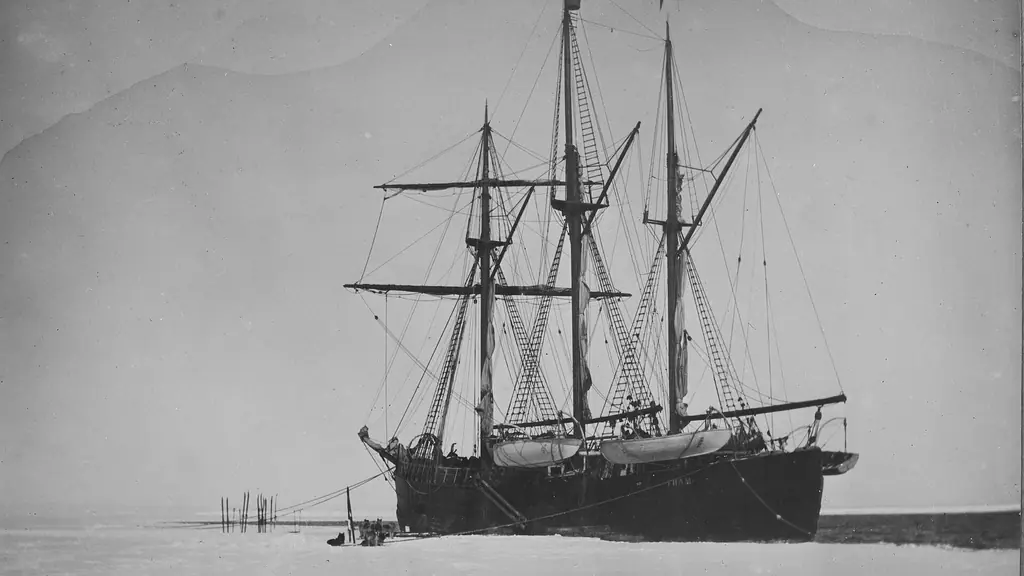
Previous expeditions had tried to force ships through the Arctic pack and failed. Nansen proposed the opposite: let the ship freeze in and drift with the ice. That required a vessel unlike any built before. The Norwegian parliament granted NOK 280,000, private donors added more, and the boat-builder Colin Archer designed and built the Fram ("Forward") with Nansen and the expedition's captain, Otto Sverdrup (Fram Museum).
The key was the hull shape. Instead of resisting the ice head-on, the rounded hull was designed so that pressure from the closing pack would squeeze the ship upwards, the way a smooth nut pops out from between pinched fingers. Other features followed from the same logic:
| Design feature | Purpose |
|---|---|
| Rounded hull, 39 m long and 11 m wide, about 800 tonnes loaded | Lifted by ice pressure rather than crushed; the wide beam added strength but made her roll badly at sea |
| Double oak ribs only 5 cm apart, gaps filled with pitch, tar and sawdust | Extreme strength against pressure |
| Outer sheathing of greenheart, a very dense timber | Could be torn off by ice without damaging the hull |
| Rudder and propeller that could be hoisted into wells | Protected from ice damage |
| Thickly insulated living quarters | A habitable home for several years |
| Windmill driving a generator | Electric light during the polar night |
The drift, 1893–1896
The Fram left Kristiania in late June 1893 with a crew of 13, sailed from Vardø on 21 July towards the New Siberian Islands, and reached the ice on 22 September 1893 (Fram Museum). Then the ice took over.
| Date | Event |
|---|---|
| 24 June 1893 | Fram sets out from Kristiania |
| 22 September 1893 | Reaches the ice north of Siberia and is frozen in |
| 14 March 1895 | Nansen and Hjalmar Johansen leave the ship with dog sledges and kayaks to try for the Pole |
| 9 April 1895 | Moving pack ice forces them to turn back at 86° 14′ N, farther north than anyone before |
| 16 October 1895 | Fram, under Sverdrup, reaches her own northernmost point, 85° 57′ N |
| Winter 1895–96 | Nansen and Johansen overwinter in a crude hut on Franz Josef Land |
| 17 June 1896 | They meet the British explorer Frederick Jackson at Cape Flora |
| 13 August 1896 | Nansen reaches Vardø; the same day Fram breaks free of the ice north of Svalbard |
| 9 September 1896 | Fram returns to Kristiania |
The drift lasted about 35 months. As the Nobel biography notes, Nansen and Johansen arrived in Vardø on the very day the Fram reached open water, and the whole party was reunited at Tromsø about a week later. All 13 men came home; the expedition archive includes a photograph of the full crew in Kristiania in September 1896. The Norwegian Polar Institute's archive of the expedition records that the drift confirmed Nansen's theory of a transpolar current and largely disproved the old idea that the North Pole lay on a large landmass (NPI archive).
What the drift revealed
The Fram was not just a vehicle; the Nobel biography describes it as an oceanographic, meteorological and biological laboratory. The scientific results filled six volumes published between 1900 and 1906. Three findings stand out.
A deep ocean with warm water inside it
The Fram drifted for hundreds of kilometres between the North Pole and Franz Josef Land, over deep ocean rather than the land some had expected. That deep basin is now called the Nansen Basin, and modern surveys put its abyssal plain at about 4,000 m. In the mid-nineteenth century some geographers had even speculated that warm currents might keep the central Arctic Ocean open. The drift showed something subtler. Below a cold, low-salinity surface layer that sat directly under the ice, Nansen found a layer of warmer water, above 0 °C, between about 150 and 600 m depth (Rudels and Carmack 2022). This was Atlantic water that had entered the Arctic Ocean and slid beneath the lighter, fresher surface water, which keeps most of its heat away from the ice. One photograph in the expedition archive shows Nansen reading a deep-water temperature on 12 July 1894.
Not every measurement was right. Rudels and Carmack note that some salinity determinations from the Fram were in error and made the deep water appear saltier than Atlantic water, which led Nansen at first to look for its source in sea-ice formation on the shelves. Using observations from Roald Amundsen's Gjøa in 1901, he later pointed to convection in the Greenland Sea instead and eventually accepted that the deep water came from there. Modern work shows both sources play a part: a good example of science refining an idea as better measurements arrive.
The warm Atlantic layer he found is the same water that oceanographers now watch rising closer to the surface in the Barents Sea and the Eurasian Basin, the process described in our article on Atlantification.
Ice that does not follow the wind
Nansen also noticed that the ice did not drift in the same direction as the wind but consistently to its right. He suspected the rotation of the Earth was responsible. The Swedish oceanographer Vagn Walfrid Ekman later used Nansen's observations to build a mathematical model, published in 1905, of how wind-driven motion turns with depth in a rotating ocean: the Ekman spiral. The resulting net movement of water, roughly at right angles to the wind, is now called Ekman transport (UCAR). It is a foundation of modern physical oceanography, explained further in Understanding Ocean Currents.
Drifting as a method
Perhaps the most lasting legacy is the idea itself: freezing a research platform into the ice and letting it drift to collect year-round observations. Our article on what scientists learn from Arctic expeditions shows how that approach has been used again in modern ice-drift campaigns.
Nansen's drift worked because he treated the ice as a moving platform rather than an obstacle. The same principle underlies today's drifting buoys and ice-tethered instruments, which ride the ice while measuring the ocean beneath.
Oceanographer, diplomat, humanitarian
After the expedition Nansen held a research professorship at the University of Oslo, published the scientific volumes and was appointed professor of oceanography in 1908. He interrupted his research in 1905 to campaign for Norway's independence from Sweden and then served as Norway's minister in London until 1908, before leading several oceanographic cruises in polar waters (Nobel Prize).
After the First World War his work changed direction entirely. For the League of Nations he organised the repatriation of around 450,000 prisoners of war, then led the League's High Commission for Refugees, created in 1921. He introduced the "Nansen passport", an identity document for stateless refugees that was eventually recognised by 52 governments, and directed relief during the Russian famine of 1921–22. He received the Nobel Peace Prize in 1922 and died on 13 May 1930.
Exploring the legacy
The Fram is preserved at the Fram Museum in Oslo, which also holds detailed accounts of the voyage. Nansen's own two-volume narrative, Farthest North, is out of copyright and widely available. His name lives on in Arctic science, including the Norwegian research project the Nansen Legacy (Arven etter Nansen), which studied the northern Barents Sea from 2018 to 2024; see The Nansen Legacy Project Explained. This site is independent of that project.
Recreate Nansen's reasoning: give students the 1881 sinking position of the Jeannette near the New Siberian Islands and the 1884 find of its wreckage on the Greenland coast, and ask them to sketch the ice drift that could connect the two. Then compare their sketch with a modern map of the Transpolar Drift.
Sources
- The first Fram expedition 1893–1896The Fram Museum
- The polar ship FramThe Fram Museum
- Fridtjof Nansen – BiographicalNobel Prize Outreach
- The Fram expedition (Nansen-Amundsen Year 2011 gallery)Norwegian Polar Institute (archived by the National Library of Norway)
- Arctic Ocean water mass structure and circulation (Rudels and Carmack 2022)Oceanography
- How seawater moves: Ekman transportUCAR Center for Science Education
Spotted an error? Email contact@nansenlegacy-symposium.com with the page address. See our editorial policy.