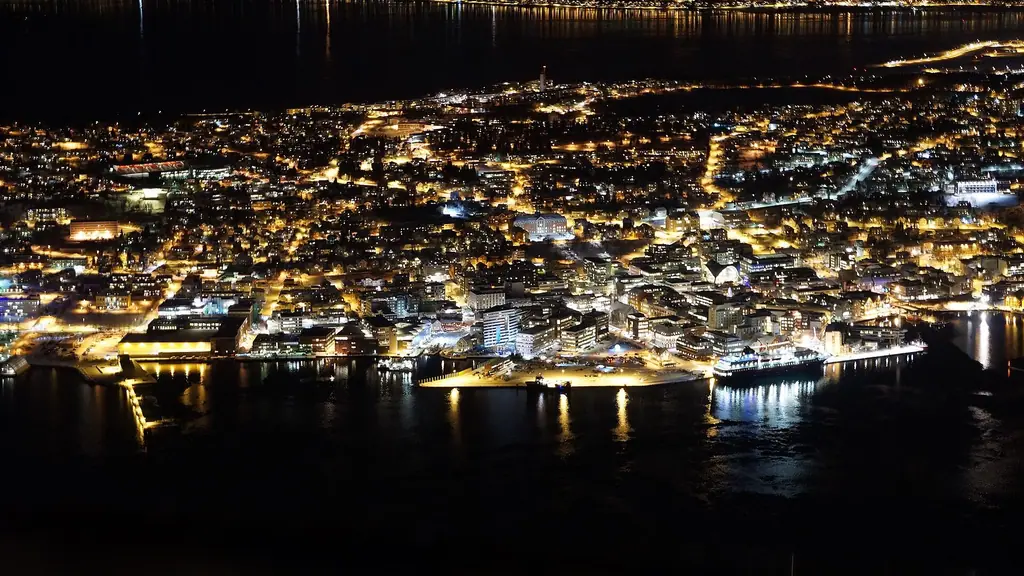

In the first week of November 2023, about 250 researchers from Norway and 18 other countries met in Tromsø, in northern Norway, for an international symposium titled "Towards a new Arctic Ocean – Past, Present, Future". The project's own press release gave that head count a few days before the meeting opened. The meeting ran from Monday 6 to Thursday 9 November. Its main programme took up the last three days, at the Clarion Hotel The Edge on the city's waterfront.
The symposium was the closing international conference of the Nansen Legacy (in Norwegian, Arven etter Nansen), a national research project on the northern Barents Sea and the neighbouring deep Arctic Basin. This page sets out what the meeting was for, who organised it and how people took part. Other pages in this archive cover the programme, the invited speakers and the practical arrangements.
What the symposium set out to do
The organisers wanted to look beyond the project's own study area. They invited the international research community to focus on the Arctic Ocean as a whole, and to bring together results from projects across the pan-Arctic region. The aim was to identify what was now understood about the region's climate and ecosystems, and where the biggest gaps in knowledge remained.
The format followed from that aim. A UArctic announcement from October 2022 described six themed sessions with talks and posters. Some sessions brought together several disciplines working on one region. Others followed a single discipline across several regions. Every morning had a plenary programme open to all participants, with broad keynote lectures, shorter invited talks, and panel debates. Some talks were labelled as "science for use" presentations, about how research findings reach managers and policymakers.
The original website said the meeting was open to natural scientists working anywhere in the Arctic, and also to people who use their results, such as stakeholder representatives interested in what was known and what might come next.
The project behind it
The Nansen Legacy brought together ten Norwegian research institutions: universities, the Norwegian Polar Institute, the Institute of Marine Research, the Norwegian Meteorological Institute and others. On its own site the project describes itself as running from 2018 to 2024, with fieldwork at sea between 2018 and 2022. Its main platform was the research icebreaker RV Kronprins Haakon. The project gives its budget as 740 million Norwegian kroner. Half came from the Research Council of Norway and the Ministry of Education and Research, and half was contributed in kind by the partner institutions. It reports that about 280 researchers, students and technicians took part.
The symposium therefore came near the end of the project. Its final reports were approved by the Research Council of Norway, as the project announced in March 2025. For a fuller account of the project's aims and methods, see our explainer on the Nansen Legacy project. For the polar explorer the project was named after, see Fridtjof Nansen and the Fram drift.
Who organised it
The original website named the Nansen Legacy project as the symposium organiser. The November 2022 "save the date" notice was signed by the project's principal investigator, Marit Reigstad, and its two co-principal investigators, Tor Eldevik and Sebastian Gerland. The archived "About the Symposium" page listed a core organising committee of five: those three, plus Cecilie Mauritzen and Ingrid Wiedmann. It also named about twenty session organisers from Norwegian and international institutions, who planned the six parallel sessions and the closing plenary.
Who came, and on what terms
Participation worked differently for different groups. Researchers from outside the project paid a registration fee. People working on the Nansen Legacy had their fees and accommodation covered by the project. Former early-career members of the project, its "alumni", could apply for help with conference costs and for a travel grant. The grant depended on distance: up to 3,000 NOK for travel within Norway, 5,000 NOK within Europe and 10,000 NOK from further away. It was available to alumni presenting data linked to the project.
Remote participation was possible too. People who registered could watch the plenary morning sessions online free of charge. Alongside the talks, the project showed a photo exhibition about Arctic fieldwork at the venue. It also released a series of fact sheets summarising its findings on topics including sea ice, biodiversity, ocean acidification and Arctic weather forecasting.
Exploring the record
The original "About the Symposium" page survives as an Internet Archive copy. The project's own records, publications and final report are on the official Nansen Legacy website. Ice Edge is an independent publication, not the project or the symposium organisers. This summary is written in our own words from those public records. The full set of archive pages is listed on the symposium archive index.
Sources
- The past and future of the Arctic explored in a major research conference in TromsøThe Nansen Legacy
- Save the date: The Nansen Legacy Symposium 2023The Nansen Legacy
- About usThe Nansen Legacy
- The Nansen Legacy symposium, Tromsø, November 7–9, 2023UArctic
- Final report approvedThe Nansen Legacy
Page last checked . Corrections to contact@nansenlegacy-symposium.com.